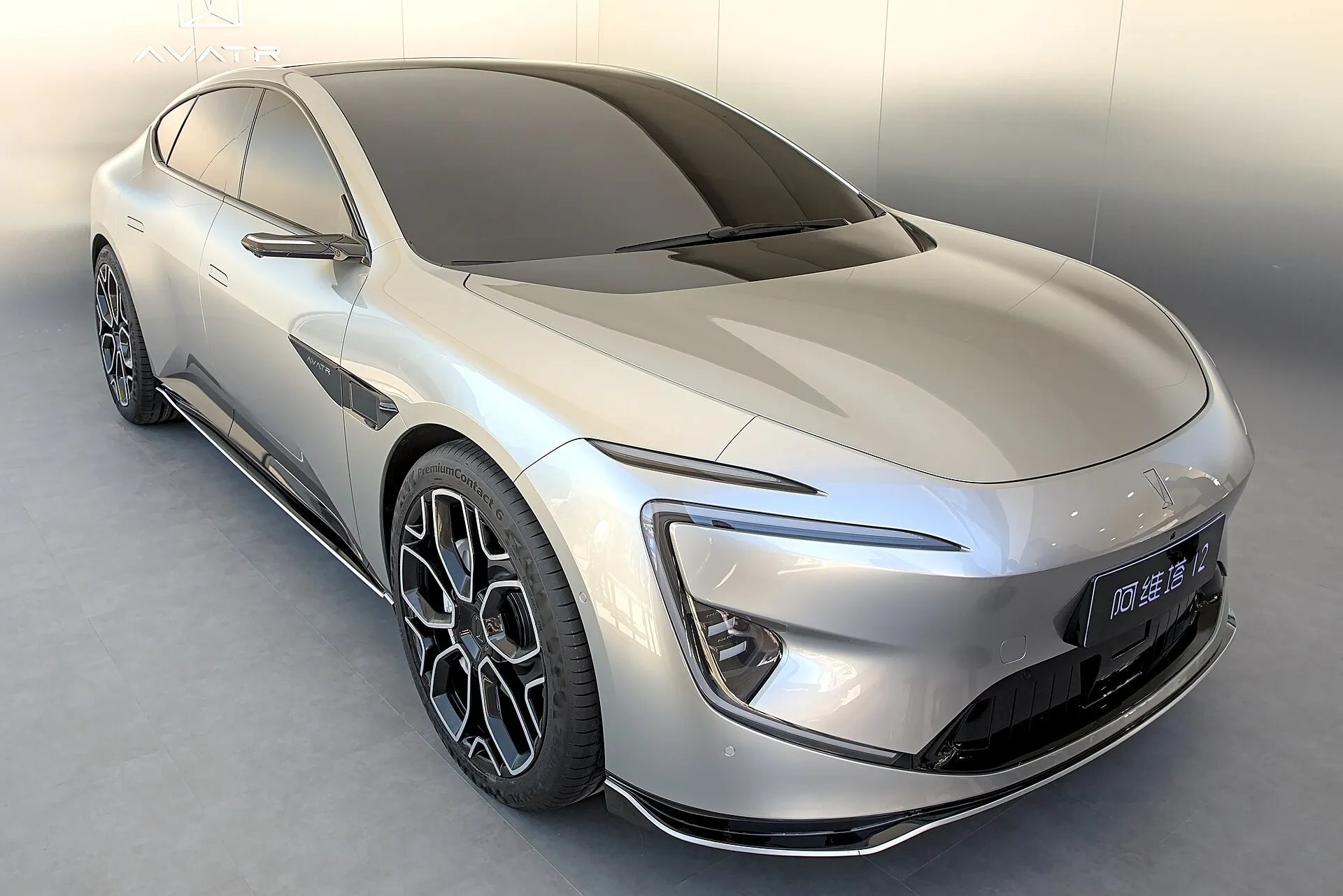
Photo by Alexander-93 on Wikimedia Commons · CC BY-SA 4.0
The Avatr 12 brings Huawei's HarmonyOS cockpit and ADS driver assistance to the UAE luxury EV segment. Here is what that software-first proposition actually means on Dubai roads, how it stacks up against the Porsche Taycan and BMW i5, and who should think twice before buying one.
A 578 hp electric gran tourer built by Changan Automobile, co-developed with Huawei and CATL, and priced from roughly AED 290,000 to AED 360,000 depending on trim - the Avatr 12 is not a brand exercise in badge prestige. It is a software argument. The entire ownership proposition rests on whether Huawei's HarmonyOS 4 in-car platform and its ADS 2.0 driver-assistance stack deliver enough real-world capability on UAE roads to justify choosing this car over a Porsche Taycan or a BMW i5.
That is an unusual pitch for a luxury EV. Most cars in this segment lead with material quality, badge cachet, or a famous chassis. Avatr leads with a phone ecosystem. Huawei's consumer electronics division - the same team that built HarmonyOS for smartphones, tablets and smart TVs - engineered the entire digital layer of the 12. That means over-the-air updates arrive on the same cadence as a smartphone OS, the navigation knows your Huawei phone's calendar, and the driver-assistance system is trained on Chinese urban data that may or may not map cleanly to Sheikh Zayed Road interchanges. All of that matters to a UAE buyer in ways that a European reviewer testing the car near Munich will never flag.
This article is built around the software and electronics, because that is what makes the Avatr 12 genuinely different. Prices are accurate as of July 2026.
HarmonyOS 4 runs on a 40.9-inch tri-screen layout: a driver display, a central touchscreen, and a passenger screen. The operating system is not a forked Android - it is a proprietary Huawei microkernel OS, which means it does not rely on Google Play Services and cannot use Google Maps natively. In the UAE, that is a practical concern. The bundled mapping solution uses Huawei Petal Maps, which covers Dubai and Abu Dhabi with reasonable accuracy but lacks the traffic-incident granularity of Google Maps or Waze during rush hour on the E11.
On the positive side, the HarmonyOS interface is genuinely fast. App switching between the climate panel, navigation, and the rear-seat entertainment console is near-instant thanks to a Kirin-based chip cluster. The system supports Huawei's SuperDevice protocol: if you carry a Huawei smartphone, it mirrors seamlessly and shares a single clipboard with the car's voice assistant. Apple CarPlay and Android Auto are supported as a fallback, which is important for UAE buyers who use non-Huawei phones - and most do.
Voice control is handled by Xiaoyi, Huawei's in-car assistant. Arabic language recognition was added in a 2025 OTA update and works well for navigation commands, but struggles with mixed Arabic-English commands common in UAE speech patterns. A workaround is switching the language mode to English, which gives better accuracy for road names like 'Al Khail Road' or 'Hessa Street'.
Huawei ADS 2.0 (Advanced Driving System) is the hardware-software stack that handles lane centering, adaptive cruise, automated lane changes, and urban assisted driving. It uses a sensor array of 3 LiDAR units, 12 ultrasonic sensors, 6 millimeter-wave radars, and 11 cameras. That hardware spec is objectively dense - more sensors than the Porsche Taycan's optional InnoDrive package.
The GCC-spec Avatr 12 ships with ADS 2.0 enabled for highway assist on defined roads. The system handles Sheikh Zayed Road and the Abu Dhabi corniche expressway well in standard conditions. It identifies lane markings painted on asphalt that has been bleached by the UAE summer sun, though performance degrades when sand haze reduces camera contrast below approximately 400-metre visibility. At 50°C ambient, the LiDAR cooling fans cycle noticeably - owners report a faint hum from the A-pillars in stop-start traffic.
Urban autonomous driving - the system's ability to navigate intersections, roundabouts, and unprotected turns without driver input - is not activated in the GCC spec as of July 2026. Huawei has stated this feature requires HD mapping of local roads before it can be unlocked via OTA. The practical implication: Avatr 12's most impressive ADS demonstration-reel content does not yet function in Dubai. Buyers should treat ADS 2.0 as a premium highway ADAS suite, not a full self-driving system.
The Avatr 12 receives OTA updates through Huawei's cloud infrastructure. Major software versions have arrived every four to six months, with minor UI and mapping updates every four to eight weeks. This cadence is faster than BMW's ConnectedDrive update cycle and comparable to Tesla's schedule for Tesla listings in the UAE. Updates are downloaded over Wi-Fi or the car's built-in 5G eSIM; in the UAE, the eSIM is provisioned on Etisalat (now e&) by default.
What OTA can change: HarmonyOS UI features, voice assistant language packs, navigation map data, ADAS calibration parameters, regenerative braking tuning, and battery management algorithms. What OTA cannot change: the underlying LiDAR hardware capability, the physical screen resolution, or the motor output ceiling. Huawei has issued two major ADS calibration updates since the car launched; the second improved automatic emergency braking response time by a measured 0.15 seconds in independent testing.
This is the most important section in this article for UAE buyers. The Avatr 12's value depends almost entirely on continued Huawei software support. If Huawei's automotive division reduces its investment - whether due to geopolitical trade restrictions, a strategic pivot, or a change in Avatr's regional distribution - the update cadence slows, and the car's competitive position against rivals erodes faster than a conventional luxury car's does.
As of July 2026, Huawei has committed to a minimum 10-year software support window for Avatr vehicles sold in GCC markets, backed by a local service agreement with the UAE distributor. This is a contractual commitment, not a marketing claim - buyers should request the specific clause in writing when signing the purchase agreement. Compare this to the BMW i5's ConnectedDrive infrastructure, which is backed by BMW Group's own software division with no third-party dependency.
There is also a resale dimension. UAE buyers who plan to resell in three to five years are entering territory without historical precedent. Avatr has no resale data track record in the Gulf. Brands like Lexus and Porsche carry well-established residual value curves in the UAE market. Avatr does not. If software support continuity comes into question, residual values could fall sharply - a risk that a Porsche Taycan buyer does not carry.
The Avatr 12 is imported via a UAE distributor and is not a GCC-official launch through a manufacturer-owned network. Customs duty on passenger vehicles entering the UAE is 5% of CIF value. Buyers should confirm with the dealer whether the listed price includes customs clearance and local compliance certification (ESMA approval), as some early units required individual vehicle type approval at an additional cost of AED 2,000-4,000.
RTA Mulkiya (vehicle registration) for a car in this value bracket costs AED 1,100 to AED 1,400 annually in Dubai, plus a knowledge and innovation fee of AED 20. Electric vehicles registered in Dubai are currently exempt from the AED 4 per-litre fuel savings comparison calculation in the standard registration model, but the basic registration fee applies. Salik toll tags are mandatory in Dubai: the tag itself costs AED 100 (refundable deposit) and each gate crossing is AED 6. A driver commuting from Jumeirah to DIFC twice daily passes two Salik gates each way, spending AED 48 per working day.
Insurance for the Avatr 12 in Dubai sits in a high premium band due to limited actuarial history with the model. Expect comprehensive insurance premiums of AED 12,000 to AED 18,000 annually at launch, compared to AED 9,000 to AED 14,000 for a comparable BMW i5 from a UAE dealer. As claims data accumulates, this gap should narrow. Prices accurate as of July 2026.
This section exists because the Avatr 12 is a genuinely compelling machine that is wrong for a significant subset of buyers who will be attracted to it.
Changan Automobile, the state-linked Chinese automaker, owns the Avatr brand in a joint structure with Huawei and CATL. Huawei's role is specifically the full digital layer: the cockpit operating system, the ADS driver-assistance platform, the connectivity stack, and the human-machine interface design. CATL supplies the battery. Changan handles the chassis, body structure, final assembly, and safety certification.
This is structurally different from, say, Zeekr's approach (Geely-owned, software developed in-house) or Tesla's (vertically integrated across software and hardware). Avatr's model means any deterioration in the Huawei-Changan commercial relationship directly affects the car's update quality. As of July 2026, the partnership is intact and actively investing in new ADS map coverage. But buyers buying a three-to-five-year ownership cycle should understand this dependency is a real variable, not a theoretical one.
The Avatr 12 is the most technically ambitious luxury EV available in the UAE at its price point. Its LiDAR density, screen real estate, rear passenger space, and CATL battery chemistry are all class-leading or competitive. The HarmonyOS cockpit is fast, polished, and genuinely enjoyable to use if you are in the Huawei ecosystem.
The correct buyer is someone who wants technology density over badge prestige, has a Huawei phone or is willing to switch, lives or works within 30 minutes of a Dubai or Abu Dhabi service centre, and plans to keep the car for five or more years while absorbing whatever the OTA update cadence delivers. That is a real buyer - there are thousands of them in the UAE. For everyone else, a certified pre-owned Porsche Taycan or a new BMW i5 from an authorised UAE dealer remains the lower-risk path to a premium electric grand touring experience.
إخلاء المسؤولية: هذا المقال لأغراض المعلومات العامة فقط ولا يُعد استشارة قانونية أو مالية أو ضريبية أو تأمينية. الأسعار والمواصفات والتوافر إرشادية وتختلف حسب الفئة ومواصفات الخليج، وقد تتغير دون إشعار - يُرجى تأكيد الأرقام الحالية مع الوكيل البائع. الرسوم الحكومية وإجراءات التسجيل والاستيراد والجمارك وأنظمة المرور قابلة للتغيير؛ تحقق دائمًا من المتطلبات الحالية مباشرةً من الجهة المعنية في الإمارات (هيئة الطرق والمواصلات، وزارة الطاقة والبنية التحتية، الجمارك، إدارة المرور في إمارتك، أو شركة التأمين) قبل اتخاذ أي إجراء. كارزل منصة إعلانية: المركبات معروضة ومُباعة من قِبل وكلاء مستقلين مرخّصين، وكارزل ليست طرفًا في أي عملية بيع.
درهم 1,195,000