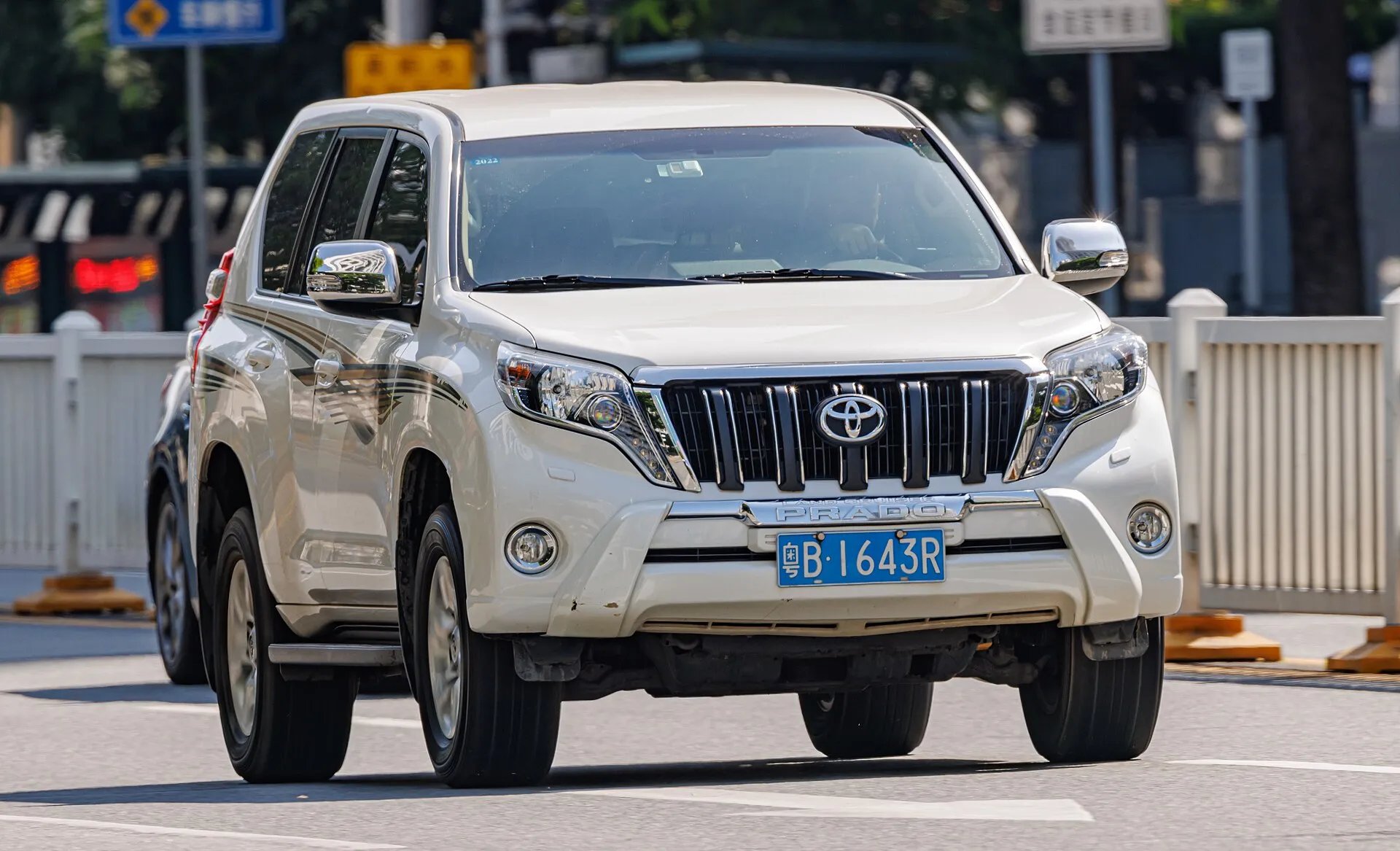
Photo by Dinkun Chen on Wikimedia Commons · CC BY-SA 4.0
Buying an American-spec Toyota or a Japanese-import Lexus in the UAE can save you AED 30,000-60,000 upfront - but the resale penalty, insurance complications, and RTA registration hurdles can cost you far more over three years. Here is the full breakdown for UAE buyers in 2026.
Walk the dealer floors along Sheikh Zayed Road on any given Friday and you will hear the same sales pitch whispered between rows of gleaming SUVs: 'Same car, sir, but AED 40,000 cheaper - it came from the US.' The temptation is real. A non-GCC-spec Land Cruiser or an American-market Chevrolet Tahoe can look identical to its Gulf-specification twin at first glance. Under the skin, however, the differences are significant enough to reshape your total cost of ownership, your bank's willingness to finance, and ultimately the price you will recover when you sell.
This article is not about which model holds value best in the UAE - that ground is covered elsewhere on Carzle. This is specifically about how the origin of a car's specification affects every financial decision you make from the moment you sign the purchase contract to the day you hand over the keys to the next owner. The data is drawn from RTA registration rules, UAE insurance market norms, and the lived experience of buyers who have navigated both sides of this equation in 2026.
GCC specification is not a marketing label. It is a defined engineering package that manufacturers such as Toyota, Nissan, BMW, and Mercedes-Benz develop specifically for the Gulf Cooperation Council climate. The key hardware differences include a heavy-duty cooling system calibrated for sustained ambient temperatures above 45°C, an air-conditioning compressor with higher capacity (typically 20-30% larger than the equivalent North American unit), corrosion-resistant undercoating formulated for coastal humidity, and fuel system components tuned for the 95-RON unleaded petrol widely available at ENOC and ADNOC stations across the UAE.
Summer heat-soak is the most underappreciated factor. When a car sits in a Dubai parking structure in July, the cabin temperature can reach 70°C or higher. A GCC-spec AC system is designed to pull that temperature down to a comfortable level within three to four minutes of startup. American-spec systems, tuned for North American summers that peak at 35-38°C, take considerably longer and place more sustained stress on the compressor. Over three to five years of UAE operation, that stress shows up as earlier compressor failure, higher maintenance bills, and a lower auction valuation.
An authorised UAE dealer warranty is transferable to the next owner and is one of the most powerful resale tools you hold. A GCC-spec Toyota Land Cruiser purchased new from Al-Futtaim Motors carries a five-year/unlimited-kilometre manufacturer warranty that moves with the vehicle log. An American-import Land Cruiser carries no UAE warranty at all - the North American warranty is void the moment the car crosses a non-US border. The practical consequence is that when you list that imported Land Cruiser for resale, every serious buyer will knock AED 15,000 to AED 25,000 off their offer to self-insure against mechanical risk during the remaining ownership period. Browse GCC-spec Land Cruiser listings on Carzle to see how warranty status is disclosed in dealer listings.
Banks take the same view. Most UAE lenders - including Abu Dhabi Commercial Bank, Emirates NBD, and Mashreq - will not finance a non-GCC-spec vehicle beyond 60% loan-to-value, compared to the standard 80% LTV offered on GCC-spec cars. That 20-percentage-point gap means a buyer purchasing your American-spec car must bring a larger cash deposit, which shrinks your pool of qualified buyers and pushes your negotiated price downward.
The Roads and Transport Authority governs vehicle registration for Dubai, and its procedures for importing a non-GCC vehicle involve several steps that do not apply to a GCC-spec purchase. According to the official process outlined at rta.ae, an imported vehicle must undergo a conformity inspection at an approved centre, where inspectors check that the car meets UAE Federal Traffic Law safety standards. If the car requires modifications - such as adding daytime running lights to a Japanese-domestic-market (JDM) vehicle, or converting speedometers from mph to km/h on an American-spec car - those modifications must be completed and re-inspected before a Mulkiya (registration card) is issued.
The RTA annual Mulkiya renewal for a standard passenger vehicle costs AED 370 regardless of spec origin, but the one-time conformity inspection and modification costs for an import can add AED 3,000 to AED 8,000 to the true landed cost of the car. Factor in the 5% customs duty levied by UAE Customs on the CIF value of the vehicle, and the upfront savings on an American-spec car begin to erode quickly. Check current import duties and procedures at customs.gov.ae.
A significant proportion of American-import vehicles reaching the UAE were declared total losses (salvage-titled) by US insurers following flood damage, collision, or hail events. The vehicle is then exported, cosmetically repaired, and sold in markets where title history databases are not cross-referenced. In the UAE, there is no single mandatory VIN-level history database that dealers must check before resale - which places the burden of due diligence entirely on the buyer. A car with a US salvage title that enters the UAE and obtains a clean Mulkiya still carries the structural and mechanical risks of its damage history, even if that history is invisible to the RTA system.
For any imported vehicle you are considering, commission a third-party technical inspection at an RTA-approved testing centre and request a written mechanical report. For American-market cars, ask the seller to provide the original US title document. A clean title will read 'Clean' in the status field; a salvage title will read 'Salvage' or 'Rebuilt.' If the seller cannot produce the original title, treat the absence of documentation as a serious red flag. This single step protects you from a resale scenario where a future buyer's due diligence uncovers what yours did not.
Let us be concrete. A 2026 GCC-spec Nissan Patrol Platinum in the UAE carries an MSRP of AED 259,000 from Nissan's official UAE network. A comparable American-spec Patrol (sold as the Armada in North America) imported privately and registered in Dubai typically trades at AED 180,000 to AED 210,000 in the resale market - a discount of AED 49,000 to AED 79,000 versus the GCC-spec equivalent. That gap reflects the compounded effect of no warranty, lower bank LTV, AC system uncertainty, and buyer hesitation about modification history. Prices accurate as of July 2026.
The picture is similar across premium segments. A GCC-spec Lexus LX listed on Carzle will attract a meaningfully stronger offer than a Japanese-domestic-market LX imported via grey channels, even if the JDM version has lower mileage. UAE buyers in the AED 400,000-plus segment are acutely aware of warranty status and authorised-service history, and they price the risk premium accordingly. For used Nissan listings in the UAE, GCC-spec cars consistently command stronger resale prices than non-GCC equivalents at equivalent mileage.
UAE insurers price risk by referencing the car's registered market value and its insurability. For GCC-spec vehicles, insurers use standard valuation tables maintained by the Emirates Insurance Association. For non-GCC imports, underwriters apply a loading factor - typically 15% to 25% above the base premium - to account for parts availability risk, uncertain repair history, and the absence of a local parts distribution network. On a car with a comprehensive premium of AED 6,000 per year, that loading adds AED 900 to AED 1,500 annually, compounding the ownership cost over a three-year hold.
Some insurers will decline to cover heavily modified imports or cars with incomplete documentation outright. If you are purchasing an imported vehicle, obtain your insurance quote before signing any purchase agreement. Discovering that your preferred insurer will not cover the car - or will only offer third-party liability - after the transfer is one of the most expensive mistakes a UAE buyer can make.
Salik toll gates on Sheikh Zayed Road and Al Maktoum Bridge charge AED 4 per crossing, regardless of whether your car is GCC-spec or imported. Parking fees in Dubai's paid zones are similarly spec-agnostic. Where spec origin does affect running costs is in fuel economy and parts pricing. American-spec engines are often tuned for 87-octane fuel, but the UAE's standard petrol grades are Special (91 RON) and Super (95 RON). Running an American-spec engine long-term on 95-RON fuel is not harmful, but you are paying for an octane rating the engine is not calibrated to use efficiently. Conversely, some JDM engines require 98-RON premium fuel that is not widely available at UAE forecourts.
Among the brands available through authorised UAE dealers, GCC-spec vehicles from Toyota, Nissan, BMW, Mercedes-Benz, and Lexus consistently show the strongest three-year resale retention. The BMW UAE model lineup and Mercedes-Benz UAE both publish GCC-spec MSRP pricing that gives buyers a transparent benchmark for negotiation and resale comparison. For ultra-luxury imports like Bentley or Rolls-Royce listed on Carzle, the GCC-spec premium is even more pronounced because authorised dealers offer bespoke Gulf-specification features - including enhanced thermal insulation and climate-sealed electronics - that simply cannot be retrofitted to a non-GCC car.
The upfront savings on a non-GCC-spec car are real. So are the downstream costs. When you model the full three-year cost of ownership - factoring in the RTA conformity inspection, customs duty, higher insurance loading, lower bank LTV (which ties up your own capital), and the resale discount you will absorb at exit - the economics of most American or Japanese imports are negative versus their GCC-spec equivalents. The exception is ultra-rare JDM variants that have a collector following in the UAE, but that is a niche play requiring specialist knowledge that most buyers do not have.
If you are buying to drive for three to five years and then sell, GCC spec is the structurally sound choice in the UAE. If you are buying a non-GCC car, price the risk correctly: get the mechanical inspection report, verify the title history, confirm your insurance quote in writing, and build the resale discount into your purchase price from day one. The UAE market in 2026 is more informed than it was five years ago, and buyers at resale time will have done their homework.
إخلاء المسؤولية: هذا المقال لأغراض المعلومات العامة فقط ولا يُعد استشارة قانونية أو مالية أو ضريبية أو تأمينية. الأسعار والمواصفات والتوافر إرشادية وتختلف حسب الفئة ومواصفات الخليج، وقد تتغير دون إشعار - يُرجى تأكيد الأرقام الحالية مع الوكيل البائع. الرسوم الحكومية وإجراءات التسجيل والاستيراد والجمارك وأنظمة المرور قابلة للتغيير؛ تحقق دائمًا من المتطلبات الحالية مباشرةً من الجهة المعنية في الإمارات (هيئة الطرق والمواصلات، وزارة الطاقة والبنية التحتية، الجمارك، إدارة المرور في إمارتك، أو شركة التأمين) قبل اتخاذ أي إجراء. كارزل منصة إعلانية: المركبات معروضة ومُباعة من قِبل وكلاء مستقلين مرخّصين، وكارزل ليست طرفًا في أي عملية بيع.
درهم 210,000

درهم 1,349,000